Unknown's avatar

About tadbartlett

I am special counsel at Fishman Haygood LLP, focusing on appeals in all matters, as well as litigation in environmental land-damage, coastal land-loss, and complex commercial matters. I am also a writer, and I'm the managing editor of literary journal The Peauxdunque Review.

New post about old but good news

For awhile now, we have known about the Peauxdunque performance in the 2011 William Faulkner-William Wisdom Writing Competition, held in conjunction with the annual Words and Music Conference, but now the Words and Music folks have updated their website with the official announcement of winners and finalists.

Of course, at the top of the Peauxdunque heap is Terri Stoor, who won the gold medal in the short story category for her story “Bellyful of Sparrow.” Judging the short story category was Harper Collins editor Michael Signorelli, who said of Terri’s story:

“A Bellyful of Sparrow” balances the horror of life with the humor. The mute, immobile, terminally ill narrator wryly observes the life around him, while also inspiring unexpected attention from friends and family. But what could be a dirge is instead quietly mirthful. The story upends expectation and strikes for the elusive territory between bemusement and solemnity. And carried by the strength of its naturally engaging prose-voice, it succeeds.

Terri was also named second runner-up in the essay category of the competition for essay “Bird Dog.” Joining her in placing as finalists in the competition, Maurice Carlos Ruffin was a finalist in the short story category for his “Ten Stories”; J.Ed. Marston was a finalist in the poetry category for his “Voyage of the Limit Perfected Fish”; and Tad Bartlett was a finalist in the poetry category for his “new century/old century: three acts.”

Terri with her gold medal, with Jeff Kleinman, agent and founding partner of Folio Literary Management

Other placings in the competition by Peauxdunqians include: Sabrina Canfield on the short list for finalists in the novel-in-progress for “To the Place Where They Go”; Sabrina was also on the short list for finalists in the essay category for “Spring Sparks Sure Shot”; Tad and J.Ed. cowrote a manuscript on the long list for finalists in the novel category, “Kites, Quite Tall”; Sabrina also had a manuscript on the long list for finalists in the novel category, “Birds of Paradise”; J.Ed. made the semi-finalist list in the short story category with “No Accidental Fall”; and Tad joined J.Ed. on the short story semi-finalist list with “The Non-Artists.”

Peauxdunquian update: publication and residency

Maurice Carlos Ruffin‘s short story, “The Pie Man,” will be published in the South Carolina Review in fall 2012. “The Pie Man” was previously awarded with the 2011 Ernest Svenson Fiction Award in the University of New Orleans’ Creative Writing Workshop; and an earlier version of the story was named first runner-up in the short story category of the 2010 William Faulkner-William Wisdom Writing Competition.

Peauxdunqian Emily Choate has been selected for a residency in the ISLAND Hill House Artist Residency program, supported by the Institute for Sustainable Living, Art & Natural Design in Michigan.

End-of-year plaudits roll in for Friends of Peauxdunque

Here in Peauxdunque, we are not just a bunch of navel-gazing narcissists (though we do not deny the charge), but we also want to celebrate the great fortune of our friends (hereafter “Friends of Peauxdunque” or “FOPs”)! The end of 2011 brought much in the way of good news for our various friends, auxiliaries, benefactors, etc. (NOT hereafter “FABFEs”).

Tom Carson‘s novel, Daisy Buchanan’s Daughter, was named to the Washington Post‘s “Notable Fiction of 2011” list; and was also included in a Vanity Fair article discussing trends in genre-bending.

Mat Johnson‘s Pym also appeared on the WPNotable Fiction of 2011” list, as well as Salon.com’s Best Fiction of 2011 list. It was also featured in Vanity Fair’s list of “The Best Books of 2011 You Haven’t Read” (which listing might be a mixed blessing, come to think of it). Actually, it might be easier to try to compile a list of the “Best of 2011” lists that Pym isn’t on. A small sampling of additional lists includes The Houston Chronicle, The A.V. Club, and Library Thing. Recall that Mat, winner of the 2011 Dos Passos Literature Prize, came and read at Peauxdunque’s Yeah You Write literary concert at Tipitina’s this past fall.

Tom Franklin, in whose workshop several Peauxdunqians landed during last summer’s Oxford American Summit for Ambitious Writers, has garnered a passel of awards for his novel, Crooked Letter Crooked Letter, including toward the end of 2011 the Crime Writers Association’s Golden Dagger.

Great work, folks. Peauxdunque’s glad to know you, and hopes 2012 brings even more of the same!

Peauxdunquians update

A quick update on the accomplishments and travels of that odd species of the writing world, the Peauxdunqian. Esteemed member Joselyn Takacs, currently in the MFA program at John Hopkins University, was recently named a finalist in Narrative’s 30 Below Contest for her story “Flares of Little Warning.” Also, Peauxdunquian Emily Choate, pictured below presenting at a December 1 reading at the Kimmel Harding Nelson Center for the Arts in Nebraska City, recently completed a six-week residency at KHN.

Peauxdunquians read at Words and Music

On November 9, the Peauxdunque Writers Alliance helped kick off the 2011 Words and Music Conference in New Orleans, with four Peauxdunquians invited to read at the Words and Music Writers Alliance annual meeting in the Cabildo, which fellow Peauxdunquian (and award-winning filmmaker) Helen Krieger caught on video.

First up was Terri Stoor, gold medal winner in the short story category of the 2011 William Faulkner-William Wisdom writing competition, who read “Bird Dog,” her second-runner-up entry in the Faulkner-Wisdom competition’s essay category:

Following Terri, Tad Bartlett read his poem, “new century/old century, three acts,” which was a finalist for the 2011 Marble Faun Poetry Prize:

J.Ed. Marston then read a trio of poems, “Mangy Brown Dog,” “Limit-Perfected Fish,” and “Steel on Wood.” “Limit-Perfected Fish” was also a finalist for the 2011 Marble Faun Poetry Prize:

Finally, Maurice Carlos Ruffin read two flash fiction pieces, “Cocoons” and “Mercury Forges.” “Mercury Forges” will be published in the upcoming Apalachee Review:

Words and Music will continue through November 13, with most events happening at the Hotel Monteleone.

Upcoming publications and readings

From time to time, we will update the site with upcoming publications and readings by Peauxdunquians (so come on, y’all, let’s get to work!).

Coming up in less than two weeks, four Peauxdunquians have been invited to read from recent work at the Words and Music Conference put on by the Pirate’s Alley Faulkner Society in New Orleans. On Wednesday, November 9, beginning at 4:00 p.m., Words and Music will host an event of readings on the conference theme, “Life & Literature in the Global Village,” in the second floor gallery of the Cabildo. The event will be led by nationally acclaimed poet and LSU writer-in-residence Laura Mullen, and will feature new work by New Orleans poet Brad Richard. Also reading from new and recent work will be Peauxdunquians Maurice Carlos Ruffin, Terri Stoor, J.Ed. Marston, and Tad Bartlett. Also scheduled to read will be New Orleans poet (and gold medal winner in the poetry category of the William Faulkner-William Wisdom competition) M’Bilia Meeker.

In publication news, Maurice will see his story, “Mercury Forges,” published in issue 36.2 of REAL: Regarding Arts & Letters, and his essay, “Cheating the Muse,” published in issue 62 of The Apalachee Review.

Quick Peauxcrunque recap

There will be a proper debriefing and a full posting of gratitude and wonderment in the next few days, complete with the brilliant pictures taken by our many friends last night, but for now these quick thoughts on Yeah, You Write 

Terri spun golden morphine threads; and Kelly made us all dance uncontrollably and exclaim involuntarily and think unfetteredly; and Bill put us right there on a Staten Island street at four in the morning, where we were angry at the audacity of evil; and Amanda hung us in a tree, afraid of a washing machine, perfectly one with tornado-green clouds; and Gian made us the poets with him, and us of this city with him, and he created this “us” out of this crowd of “I”s; and then Mat “Poison in My Cock” Johnson — well, what more can you say — except there was joy and fear and intensity of a level even higher than any all night when Mat took the stage.

And then there was excellent Mr. Nick Fox, an emcee like no other (who you must employ for your next show, whatever it is, because you simply will not believe how he turns a mere event into a Spectacle)! And, of course, without DJ Seppe spinning the tunes before and during and after the everything, it could have been just another reading in just another room.

But this wasn’t just another room. This was Tipitina’s, the Temple of ‘Fess. We had writers on stage at Tipitina’s, goddamnit, and it felt right and it felt good. Thank you, Tip’s. Thank you, Terri and Kelly and Bill and Amanda and Gian and Mat. Thank you, Faulkner House Books for being there to sell our performers’ books. Thank you, Emilie Staat for making it all happen.

And that was the brief recap.

Yeah, You Write! Get PeauxCrunque with Peauxdunque …

Peauxdunque is one day away from the first Yeah, You Write event, a literary concert and DJ dance party (ya’ heard?) at Tipitina’s on October 13th! Doors open at 7 p.m. and show starts at 7:30. New Orleans poet and Emcee-extraordinaire Nick Fox will be presiding. Tickets are available online and are already starting to go; get yours now! Want to hear more about Yeah, You Write? Listen to this interview of Peauxdunquian Emilie Staat and featured performer Amanda Boyden by WYLD’s Hal Clark.

Our featured performers have been busy in the lead-up to Yeah, You Write, sharing their insights on writing and living in interviews by Peauxdunquians Maurice Carlos Ruffin, Emilie Staat, and Tad Bartlett. Check out the interviews with Mat Johnson, Amanda Boyden, Kelly Harris-DeBerry, Bill Loehfelm, Gian Smith, and Terri Stoor, then get ready for some great, one-of-a-kind wordage and a Peaux-Funquey dance party at Tip’s, tomorrow!

PWA Interviews Kelly Harris-DeBerry

Poet Kelly Harris-DeBerry will be reading from her work at the Yeah, You Write literary concert at Tipitina’s on October 13th. Kelly and Peauxdunquian Tad Bartlett shared an email exchange over the weekend about the power of poetry and the meaning of “literary activism”:

Tad: Kelly, you are known around New Orleans as not just a poet, but also as a “literary activist.” Assuming you consider that a fair descriptor, what does it mean to you to be a “literary activist”?

Kelly: I don’t know what people mean when they use the phrase literary activist. I hope it means I’m a good trouble-maker. I care about how people are cared for, especially when it comes to literacy and the literary arts. I’m involved in two organizations whose work is about service to both children and women in this city as it relates to literacy and literary equality.

I work in the adult literacy field. Each day I see how illiteracy affects an individual’s ability to fully participate as a citizen in society. After Katrina an alarming number of residents could not get the assistance they needed because they couldn’t read or read well enough to understand the forms. During the BP Oil Spill, The Literacy Alliance of Greater New Orleans was hired to take BP claim forms and convert them into plain language. Again, people couldn’t get services due to them because of literacy and language barriers.

Two things concern me greatly about literacy in New Orleans: 1) I believe literacy is a justice issue. It’s always been a justice issue. If Black folks didn’t know how to read and interpret U.S. laws, we’d still be in courts fighting Jim Crow. The current language on ballots and in proposed legislation is becoming so purposely complex that many people may not understand how to vote. 2) Each day it becomes clearer that much of adult education is about getting learners to achieve specific benchmarks, but we rarely get an adult learner or, let’s say a GED graduate, to the pleasure of reading. I want to take GED graduates on field trips to local bookstores and libraries to make reading applicable in daily life beyond passing a test or applying for a job.

TB: So it sounds like you have taken way more on your plate than what is commonly perceived to be the typical job description of “poet”?

KH: I am interested in how poetry can function in public places beyond bars and traditional readings. Too often writers are reading to the choir. The other day a woman came up to me in the grocery store and said, “Aren’t you that poetry lady?” There’s a certain gratification in being recognized by a non-writer. There’s a special relationship in New Orleans, it seems, between community and artists. Many of the artists in New Orleans themselves are an extension of the community. I don’t sense that artists here seek to dictate what art is or its function. Go to the French Quarter and people are artists because they say so (for better or worse).

Poems and Pink Ribbons [tb: a workshop and reading series for breast cancer patients, survivors and loved ones, presented by the Literary Lab with a final reading and celebration on October 22 at 2372 St. Claude Avenue] was in my heart for about four years. I just sat on it. The combination of having a mother who survived breast cancer, and a mother-in-law who didn’t, provoke me to want to honor them with service. Everybody wears pins and walks, but I wanted to do something more impactful, hence Poems & Pink Ribbons. Different poets around the city have volunteered their time. The majority of the participants probably wouldn’t have called themselves “poet” prior to the workshop. They’ve become more organized, more serious poets as the weeks have gone by. One lady even has a binder and she organized her binder into class notes, poem hand outs and poems that she’s been writing. Poems & Pink Ribbons has an engine of its own now and I am just along for the ride.

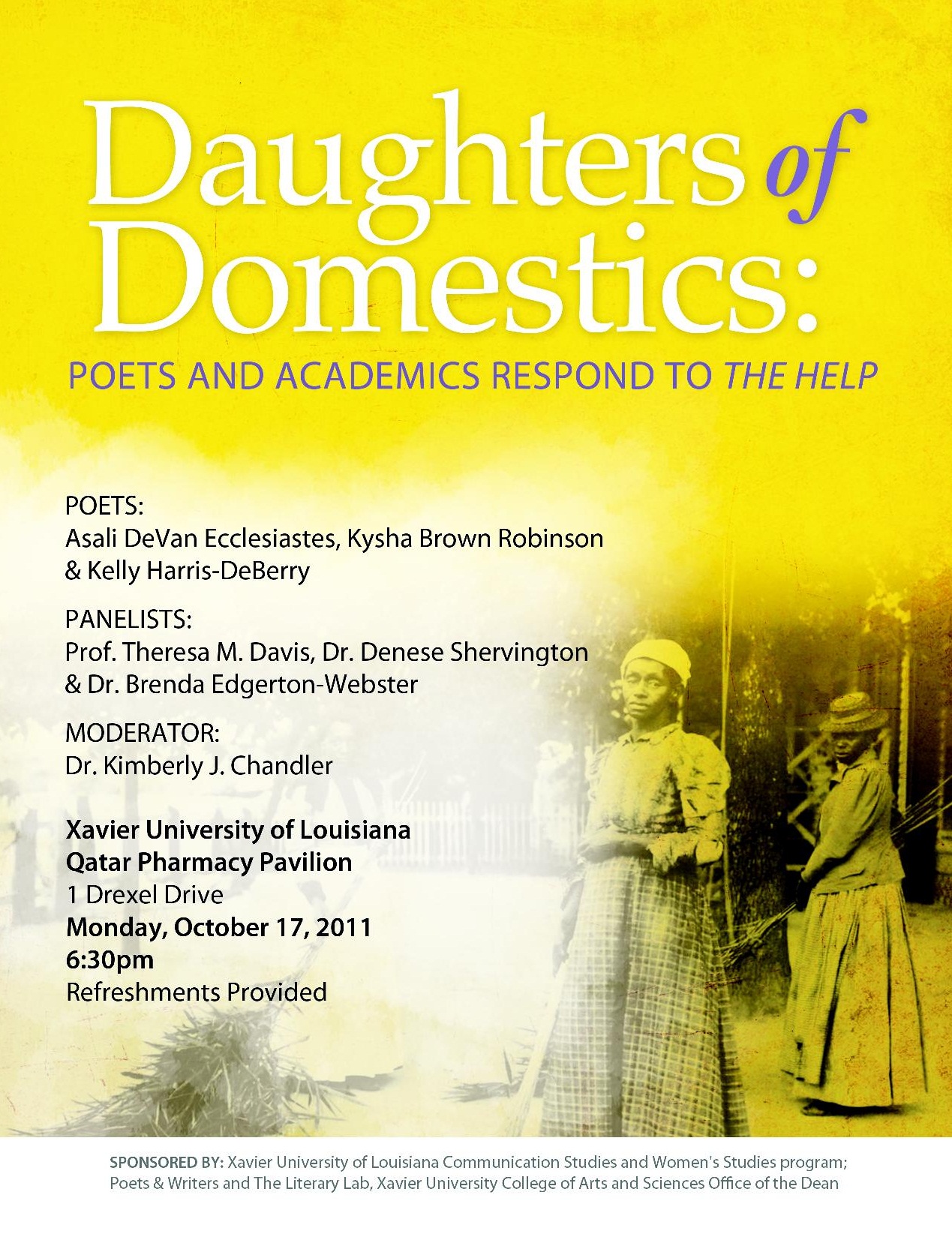
Another event that is drawing interest from beyond the universe of writers is “Daughters of Domestics: Poets & Academics Respond to ‘The Help’.” [tb: a response to “The Help” by poets and academics, on October 17 at 6:30 p.m. at the Xaview University Qatar Pharmacy Pavilion at 1 Drexel Drive]. It started from a poem I was writing about my own mother, who at various times in the late 80s and 90s cleaned homes for white owners. My mother turned 60 this year and for some reason it made me go public in my poetry about my mother’s cleaning days. Five months later “The Help” was released in theatres.

TB: What responsibility do you think that writers have beyond the mere expression of an idea or the telling of a story?

KH: I can’t say what other writers should be responsible for. I can only say I feel a responsibility to write well and with care about everything. A janitor approached me after a reading and said, “I don’t like poetry, but I like your stuff,” and I asked him why he didn’t like poetry, and his answer suggested that he didn’t know poetry could include him. I suggested some books and poets for him to read; I hope if I ever run into him again, his views on poetry will have changed.

I’m told my great-grandmother wanted to be a poet. I never met her. Apparently her ability to recite poems to her children in her living room and in church was electric. She was laughed at in her community and scolded about staying in her place. So I do kind of feel this responsibility to be true to the people and things that have impacted my life.

TB: Turning to your poetic work, I find it interesting how you are able to use the lens of uniquely New Orleans culture to create sharp focus on more general cultural phenomena; for example, in your poem “Michael’s Second Line,” which explores the greater cultural tribute to Michael Jackson upon his death through the very specific New Orleans death ritual of the second line. Or maybe it’s the other way around, using Michael Jackson as the lens through which to focus on New Orleans. Which way does it go, and is that a familiar theme in your work? [a clip from the second line that inspired “Michael’s Second Line”]

KH: Like photographers, I think poets should use a wide range of lenses to capture different angles and depth in their work. The poem functions as a New Orleans lens. The MJ second line closed the gap between icon and fan. MJ, this larger than life person, became a marcher, strutter in the line. There was some controversy about having a second line for Michael Jackson because he’s not a N.O. musician and because of the molestation controversy. However, the second line is about burying and blessing the hurt, The people are the judges; they deem who’s worthy of the ritual. It was fascinating that this larger than life person becomes everyday people – everyday New Orleans, if only for a moment.

I’m from the Mid-West—Cleveland, OH.  Many of my poems reflect blue collar ideals. I must admit moving South has sharpened my sense of place and people in my work.

TB: Another of your poems, “A Pissed Off Bird,” gives voice to an avian spokes-bird with a long list of grievances about the ruin the human race has made of birds’ initial deal with God. It swerves from acerbic humor to a lush imagining of a bird’s uninterrupted world, to dead-on social commentary. Is this a hard balance to strike, to keep the pace in a poem, to address serious social issues, and at the same time avoid any semblance of preachiness?

KH: A local music writer once said, a good trumpeter resists playing every note and trick he knows. Many singers ruin the National Anthem because they can’t resist oversinging. Ever felt like you just heard an audition instead of the sacred song? I think poets have to resist making junk drawers out of poems. It’s hard to create balance in life and poetry. And sometimes you just have to resist saying yes to everything both in life and in the poem. I’m learning that less is definitely more. It’s all about discipline.

I wrote that poem during the BP Oil Spill.  I remember being in a certain part of town and feeling as if I had walked into a gas station. You know I never wrote an ecology-themed poem until moving to New Orleans.

TB: So, why poetry?

KH: I wish I had some fascinating story about growing up around books or having parents who were educators or getting a book I couldn’t put down, but neither is the case. The short-story is: I didn’t grow up knowing a lot about poetry. As a child, I recited Easter speeches in church. I wrote my first poem in 6th grade. It was called, “Be a Leader not a Follower”; I guess even then I was grappling with social issues. I showed it to my father.  He said, You know that’s a poem. That’s how I knew I’d written my first poem. Then, I had no concept of being a poet. Poets aren’t invited to Career Day. I wanted to be a pediatrician until high school, until I introduced a poet named Mwatabu Okantah at a school assembly in ninth grade. I was hooked and quickly learned that having notebooks of poems was no fluke. I learned I couldn’t live without making poems. Something kept drawing me to the page, catching my eye, pulling my ear. Next thing I knew, whoa, I’m a poet.

TB: What is the best piece of writing advice you have ever received or given?

KH: Wayne Brown, a Jamaican poet, told me,  “Write beyond the epiphany.”
Many thanks to Kelly for this fascinating discussion. We look forward to hearing her work at Yeah, You Write, at Tipitina’s Uptown on October 13th.